Monday, August 1, 2011

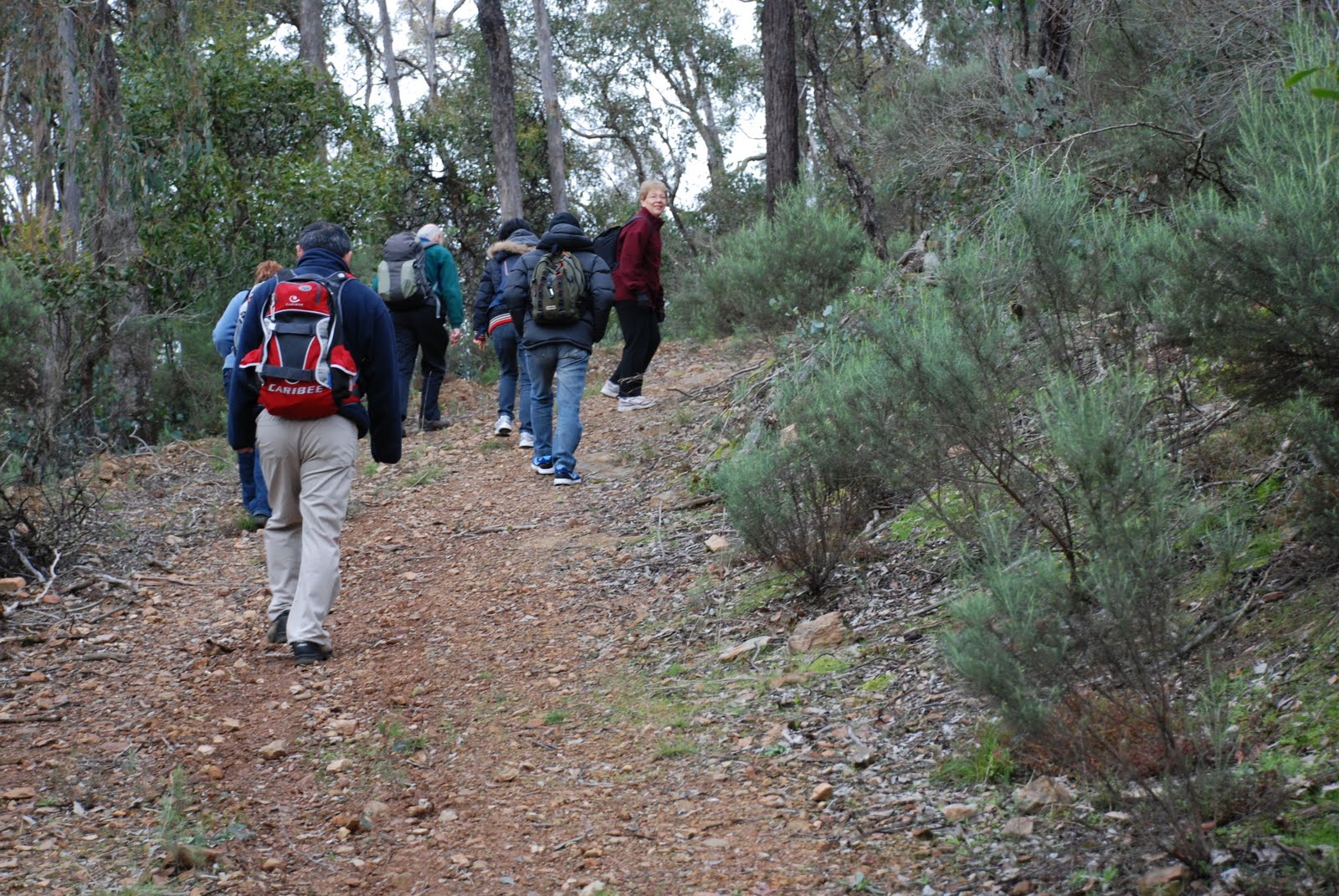
Walk Notice - Blackburn Lake to Box Hill - Saturday, 6th August.

The Walk:

We start by walking around beautiful Blackburn Lake on some nature trails. Then follow Gardiners Creek to south of Box Hill area; there are bridges and parks to explore. We will return the same way with an alternative track around the Lake.

Grade:

Easy 10 km.


Come walk with us.


Walkabouters Club of Victoria Inc.
A0019863A

Sunday, July 17, 2011

Sapling Gully - Sunday, 17th July

It's a tradition with the Walkabouters to allow plenty of time prior to the commencement of the walk. This allows time for navigation issues in new areas and for stragglers to arrive in time. It also lets early arrivals to have an extra cuppa before heading off.

Due to recent mishaps with arriving on time to walks in the Brisbane Ranges, the meeting point was in Bacchus Marsh and extra early to allow for car pooling and prevent anyone from getting lost. This tactic worked well!


With only a few kilometres to drive, from Bacchus Marsh, it wasn't long before we arrived at the start of the walk - Sapling Gully Picnic Area.

Sapling Gully is in the northern end of the Brisbane Ranges, which is 80 kms west of Melbourne. Sapling Gully is a very rocky creek bed that runs in a fairly north-south direction between the hills, and the picnic area is lies between two steep, rocky hills adjacent to the gully. In heavy rain this gully would rapidly fill with water running off from the hills, quickly becoming a raging torrent.


We started our walk, heading up Red Ironbark Track, following the ridge line toward the summit of the mountain. Our first steep incline of the day!


Red Ironbark Tree


The track crossed a tributary of Sapling Gully, which showed recent evidence of the recent floods. A lot of debris lay strewn along it's path.


 After a few initial undulations to warm us up, we commenced the steep part of the incline!


Fortunately, there were many interesting botanical observations to be made on this ascent which allowed everyone to catch their breath without anyone noticing!


Due to the recent rains, the vegetation was very lush and green. Moss was growing prolifically on the lower slopes, providing a patchwork of every possible shade of green.


There were even some tiny fungi growing amongst the moss.


As we gained altitude the moss gave way to lichen and the bushy undergrowth became more sparse.


Shortly before reaching the summit we started to encounter the odd Grass-tree here and there.


It wasn't long before we were surrounded by them!


Upon reaching the summit of the ridge, we took a few moments to indulge in some botanising.


Unfortunately, we didn't see a single orchid. Maybe it was a bit early in the season.


And then we headed down hill, toward our lunch destination.


This cave looked the perfect place for a yeti to hide, or maybe a black panther!


We took a right turn at Glider Track,


 and followed the meandering path,


 between the Eucalypts,


past a sudden drop,


through an open space,


and after a quick consultation with the trusty GPS, we arrived at our designated lunch spot.


WP - Walkabouter's Picnic

We knew it was our lunch spot because the sign in the background said so!


The Water Point looked just like the place a bunyip would live.


After lunch we headed back along Loop Track,  


past trees that were regenerating after recent fires.


We stopped to say hello to the friendly Parks Ranger,


before finding Pea Track and disappeared into it.


A brief stop to quench our thirst and to listen to a story about an aeroplane that crashed landed near here.


We quickened our pace, after the brief rest, as the temperature was became considerably colder, as a south-westerly breeze sprang up, ahead of the forecasted rain. 


After a trudge along an ascending 4WD track, we arrived back at Sapling Gully Picnic Area.


Five Walkabouters and two guests enjoyed this winter's walk through the northern part of the Brisbane Ranges. We walked 13.5 kms in total and climbed 140 metres up Red Ironbark Track to the summit of the ridge. 

Hot cups of tea and biscuits were a welcomed reward after a good days walk!


For more information, the Friends of the Brisbane Ranges  have a very informative website 
about the flora, fauna and geology of the area.

Parks Victoria also have information on tracks and walks in the area. 
See the link on the side bar to visit the website


Walkabouters Club of Victoria Inc.
A0019863A

Tuesday, July 12, 2011

Walk Notice - Brisbane Ranges – Sapling Gully - Sunday, 17th July

Grade:

Medium walking with some ups and downs, about 13 km in length.

The Walk:

This is a circular walk from the Sapling Gully Picnic Area. We should see the early spring wild-flowers and some grass-trees.


Here is a question to ponder until the walk. 

What would make an interesting collective noun for a group of Grass-trees?


Grass-tree or Xanthorrhoea spp.


If you are interested in joining us on the walk,
contact us by email for details.

 walkabouters@hotmail.com


Walkabouters Club of Victoria Inc.
A0019863A

Sunday, June 26, 2011

Royal Botanic Gardens - Sunday, 26th June


On a perfect Melbourne winter's morning, six Walkabouters and four guests 
met at Federation Square and set off for an 8 km walk through
the Royal Botanic Gardens.


It was a good thing that the campfire was going because it was sooo cold! 


We gathered around the campfire in an attempt to capture it's warmth, before heading off at a brisk pace, upstream, along the path that follows the Yarra River.


The city shone in the winter sun as the leafless boughs of trees reached over the waters edge. The path took us through Birrarung Marr Park and we stopped to look at various interesting sculptures along the way.


We crossed over the Yarra River on the Olympic Boulevard bridge and then walked up a short incline into the Royal Domain Gardens and joined the path leading towards the Royal Botanic Gardens.

We entered the Gardens through the Lych Gate.


(I looked this up on google 'cause I thought it was a spelling mistake but Lych is correct.)
A Lych Gate, for those who have forgotten, is a covered gateway that was built at the entrances to old English Church yards. The word lych comes from the old English word for corpse, so a Lych Gate is where the corpses were carried through before burial.

Anyway, we walked through the Lych Gate and were immediately struck by how luscious and vibrant the plants looked from the recent abundant rains after so many years of drought and water restrictions. Following the path past the Huntingfield Lawn we arrived at the Temple of the Winds.


The Temple of the Winds was built in 1901 on top of the hill and has commanding views over the Gardens and north, across the Yarra towards Richmond.

After a short stop to take in the views, we continued along the path down through the 'grey garden' beds,


past the Plant Craft Cottage,


...down some steps...


...and past the Northern Lawn.


The large ornamental lake was originally a billabong created by the meandering flow of the Yarra River. It provides a wonderful home for local bird life and aquatic creatures including eels. Thoughtful plantings of large trees and shrubs by Guilfoyle all those years ago has created a beautiful backdrop for the lake which make for beautiful gardenesque views.

  The land that was set aside for the establishment of Royal Botantic Gardens in 1846 by Lieutenant Governor Charles La Trobe.  Originally swampland, the area was drained and billabong was 'cut off' from the Yarra River which created the Ornamental Lake.


We walked around one of the small inlets and onto Long Island via a short bridge. Here we looked across the water towards one of the small islands and


enjoyed how the light played with the reflections on the rippling water.


After crossing Long Island we emerged on to Dog Flat just below the Hopetoun Lawn,


where an interesting large-leafed tree with a vibrant red plant growing at it's base,
caught our attention.

This new leaf looks just like a swan.

This tree is a fig tree that originates from the highlands of Papua New Guinea. It's scientific name is Ficus dammaropsis or is commonly known as the Highland Breadfruit or 'Tok Pisin' in local Papuan dialect.

The fruit of a Breadfruit Tree.


We were not sure of the name of the vibrant red plant, but it was very vibrant!!


Mystery red plant

If anyone knows what this plant is called please, leave a message below!


We continued on until we found a resting opportunity, one of many that are scattered throughout the Gardens.


On the way out we noticed another interesting plant that seemed to have a flower on it's leaf.

After closer inspection we found that indeed, there were many flowers emerging form the centre of the leaves of this plant.


This plant is called Ruscus hypoglossum and it is from the Asparagacaea family. This particular species originates from Central and Southeast Europe (Source:  wikilink).

Continuing on, we wandered past the popular Cafe and Restaurant on the Terrace next to the Lake and headed towards the Volcano!


Along the path, a surprise waited from us in some low growing trees...


....it's not every day that you see a kookaburra this close to the city!
(There were actually three of them, 2 were camera shy!) 

We walked up hill following the paths through the Eastern Lawn and arrived at Guilfolye's Volcano!

No, it's not a real volcano that spews ash into the air and stops airplanes in their tracks,


it is actually a reservoir built in 1876 to store water to be used for the Gardens.


William Guilfoyle, the second director of the Gardens, constructed the reservoir in the form of a volcano to provide a gravity fed irrigation system to water the plants.


The Volcano's reservoir was the main water supply to the Gardens for over 70 years before it fell into disrepair and lay dormant and overgrown for about 60 years. Over the last few years the team of gardeners at the Royal Botanic Gardens have worked to redesign and restore the Volcano. The pictures above show the results of their hard labour. 


It looks fantastic!

Unfortunately the Volcano's lining leaks and is currently empty for repairs. So that will mean another trip to visit the Volcano in the future.


We continued on, past some more resting opportunities  


and had lunch on the lawn next to the old Observatory Buildings


before wandering back through the Gardens on the homeward stretch.


The picture below is a bust of Ferdinand von Mueller who was the first director appointed to the Gardens in 1857.


Among his other horticulture achievements, he is also noted for  scattering blackberry seeds on many of his wanderings through Victoria because he thought the berries from the bushes would provide travelers nourishing, tasty treats on their travels.

Thanks Ferdinand, for the many scratches and torn clothes over the years!


We saw some magic puddings,


and a see through out-house that would be great for growing berry canes over,


and a sculpture with Snow Gums.


We gazed longingly at the seats in this lovely pavilion but kept walking.

With so many fascinating plants from all over the work and great views of gardenesque landscapes, our walk covered just a small sample of what the Gardens have to offer.
The Royal Botanical Garden's website is a great site to visit for lots more information.

We exited the Gardens via Gate H and joined the many people exercising on 'The Tan' and walked downstream along the Yarra, past the rowing clubs...


...and finished our walk wandering along St Kilda Road looking at the many stalls offering handcrafts at the Sunday Art's Centre Market.


Thank-you everyone for making this such an enjoyable walk
on such a wonderful Winter's day!


Walkabouters Club of Victoria Inc.
A0019863A


Related Posts Plugin for WordPress, Blogger...